

“No AI, No Job?”: Inside the AI-First Revolution at Duolingo, Shopify, and Beyond
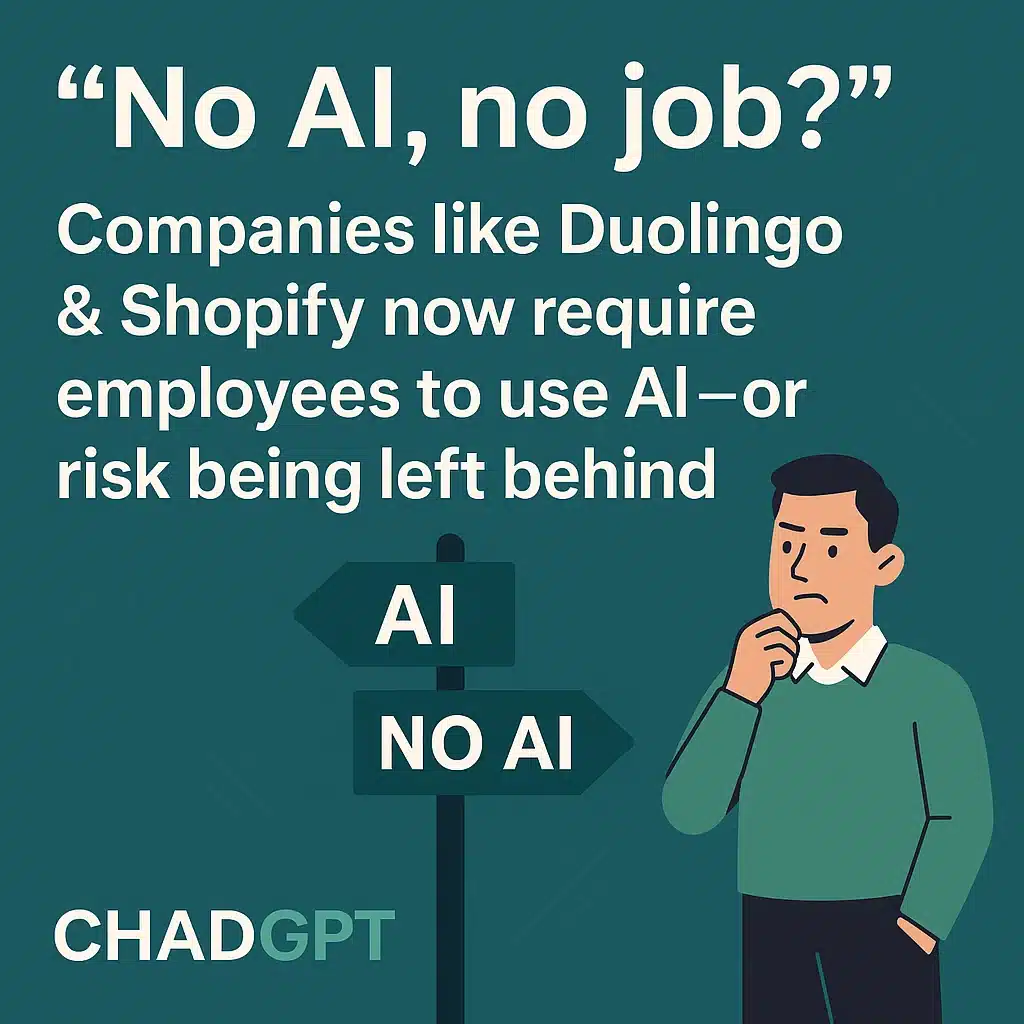
If you’re not using AI at work in 2025, you might be out of a job—or at least out of favor with your boss. Companies like Duolingo, Shopify, Box, and Meta are no longer just dabbling in artificial intelligence; they’re making it a core job requirement. Let’s break down what’s happening, why it’s controversial, and what it means for anyone hoping to keep their seat at the table.
The New Rule: AI Isn’t Optional Anymore
Here’s the headline: Executives at companies like Duolingo and Shopify are telling employees—loud and clear—that using AI isn’t just encouraged, it’s mandatory. Luis von Ahn, Duolingo’s CEO, sent a memo to his 900 staffers in April laying it out: AI is now the “central focus” of the language-learning platform. The company will stop hiring contractors for tasks AI can handle, prioritize AI skills in recruitment, and even factor AI usage into performance reviews. If you want to hire a new teammate, you’ll have to prove AI can’t do the job first (1)(3)(4).
Shopify’s CEO Tobi Lütke echoed that sentiment in his own memo: “AI will completely transform Shopify, our work, and our lives. We’re fully committed to this!” Employees are expected to learn how to integrate AI into every aspect of their roles, from prototyping to peer reviews. Teams must justify why a task can’t be automated before adding headcount (2).
The Backlash: Humans vs. the Algorithm
Unsurprisingly, not everyone’s thrilled. After Duolingo’s memo hit LinkedIn, users blasted the company for prioritizing AI over people. Language learners, in particular, questioned whether AI-generated translations could ever replace the nuance and context a human brings. Some threatened to leave the platform entirely. The uproar was so intense that von Ahn had to clarify: “I do not view AI as a substitute for our employees’ roles… I perceive it as a tool to enhance our operations, maintaining or improving quality. The sooner we adapt to and responsibly utilize it, the more advantageous it will be for us in the long term”.
Shopify faced similar criticism. One digital marketer summed up the mood: “I cannot, in good faith, endorse any company that recklessly discards its capable employees while placing unwavering trust in technology that often fails”.
How AI Is Reshaping the Workplace
So what does “AI-first” actually look like on the ground? Here’s what’s changing:
- Hiring and Firing: Duolingo and Shopify are slashing contractor roles and freezing hiring for any job AI could do. In early 2024, Duolingo cut 10% of its contract workforce after automating content creation and translation (5).
- Performance Reviews: Employees are now judged on how effectively they use AI. If you’re not leveraging these tools, you’re falling behind.
- Job Descriptions: The share of tasks in job postings that can be done by AI has dropped by 19% over the last three years, meaning companies are simply not hiring for those roles anymore.
- Learning Curve: Teams are expected to spend time experimenting with AI tools, sharing what works, and constantly iterating. Duolingo’s Chief Engineering Officer even encouraged staff to devote 10% of their time to AI experimentation.
- AI as Default: At Meta, AI is being used for “low-risk decisions” in privacy reviews, freeing up humans for more complex work. Box and Google are following suit, with Google even allowing software candidates to use AI tools in interviews—as long as they get the job done efficiently.
Is This Just a Tech Industry Fad?
Not even close. The AI-first mandate is spreading fast, especially in white-collar sectors. Microsoft, Zoom, and Google are all rolling out AI-powered features and expecting employees to keep up. Even companies outside of tech, like Intuit and UPS, are cutting jobs and reinvesting savings into AI initiatives.
Aaron Levie, CEO of Box, put it bluntly: “In engineering, we are likely in the last generation where individuals can join a company without any AI coding skills.” The message is clear: AI proficiency isn’t a “nice-to-have” anymore—it’s a baseline expectation.
The Money Angle: Why Companies Love AI
Let’s not kid ourselves—this isn’t just about innovation. It’s about the bottom line. Automating repetitive tasks with AI means companies can do more with fewer people. That translates to cost savings, higher productivity, and, yes, bigger profits. AI-related jobs are even paying more; some reports suggest entry-level AI roles earn twice the typical salary.
Duolingo’s stock price has soared 68% in the past year, thanks in part to its AI-driven approach and expansion into new markets. Shopify and Box see similar financial incentives. The logic is simple: If AI can do the job faster and cheaper, why pay a human?
But… Is It Working?
Here’s where things get interesting. Some companies are already walking back their AI-only strategies. Klarna, the fintech firm, once bragged about replacing human agents with an AI assistant. But after customer complaints about “lower quality,” Klarna started hiring humans again and admitted it needed to “invest in the quality of human support”.
The lesson? AI is powerful, but it’s not infallible. There are still plenty of tasks—especially those requiring empathy, creativity, or complex judgment—where humans outperform machines.
The Future: Adapt or Get Automated
If you’re a white-collar worker, here’s the reality check: AI is here to stay, and the bar is only going up. CEOs across the tech industry are openly saying they want fewer employees and more automation. As AI tools get smarter every month, the pressure to adapt will only intensify.
But there’s a silver lining. The companies that figure out how to blend human ingenuity with AI efficiency will have a massive edge. The rest? They’ll risk falling behind—or disappearing altogether.
Final Thoughts: The AI-First Era Is Here
The workplace is changing fast. Whether you’re excited, nervous, or somewhere in between, one thing is clear: Learning to work with AI isn’t just a career boost—it’s a survival skill. Companies like Duolingo and Shopify are leading the charge, but they won’t be the last. The only real question is: Are you ready to adapt?
