

Your Business AI Needs a Brain Upgrade: How a 19-Year-Old is Solving AI’s Biggest Memory Problem

You’re spinning a dozen plates: customer requests, project details, sales leads, internal notes, brilliant ideas you scribbled on a napkin… and then, poof. That crucial detail about Mrs. Henderson’s preferred shade of teal for her custom order? Gone. That innovative solution you brainstormed for a client last week? Vanished into the digital ether.
Sound familiar? It’s not just you. Our human brains, as magnificent as they are, simply weren’t built for the sheer volume of information we encounter daily. And here’s the kicker: for all their brilliance, even our AI tools often suffer from the same digital amnesia. They’re fantastic at generating new content or analyzing data in the moment, but ask them to recall a conversation from three weeks ago with full context, and you might get a blank stare – or worse, a confident hallucination.
But what if your AI assistant could remember everything? Every interaction, every document, every brilliant idea you fed it? This isn’t the stuff of sci-fi anymore. A 19-year-old founder, Dhravya Shah, is making waves with his startup, Supermemory, by tackling this exact problem head-on. And yes, he’s already nabbed millions in backing from heavy-hitters like Google AI chief Jeff Dean and executives from OpenAI.
Image Created by ChadGPT AI Image Creator
Think about that for a second. An AI that doesn’t just process, but remembers. For the small business owner, the solopreneur, and the lean team, this isn’t just a cool tech demo; it’s a potential game-changer. It’s the difference between constantly re-explaining yourself and having a truly intelligent, proactive partner.
The Forgetful Future? Not Anymore: What is Supermemory?
At its core, Supermemory isn’t just another flashy chatbot; it’s a universal memory API for AI applications. Now, before your eyes glaze over at the tech jargon, let’s break that down. Imagine it as a super-smart, ever-learning central nervous system for all your AI tools. Instead of each AI having a short-term memory that resets every time you close a tab or start a new conversation, Supermemory gives them a deep, interconnected long-term memory.
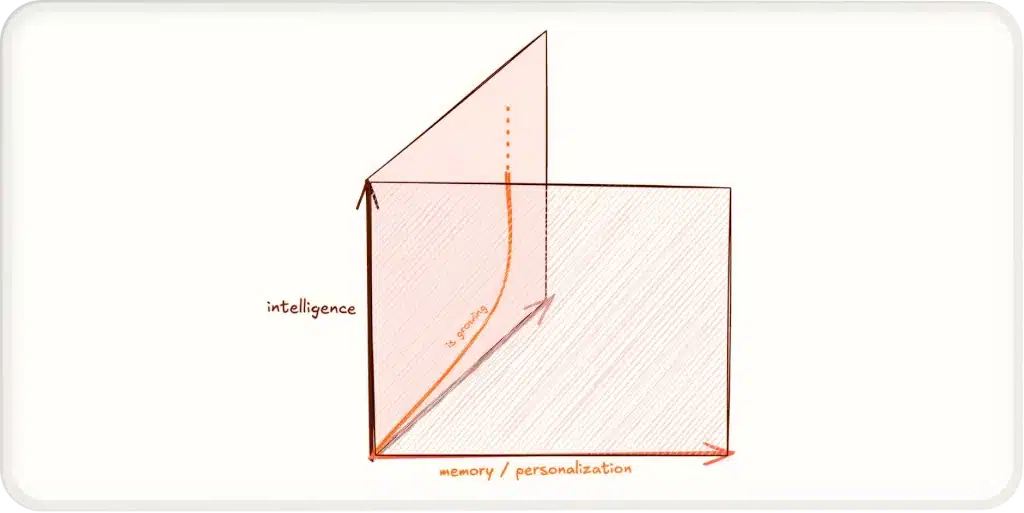
How? It works by continuously extracting “memories” or insights from the ocean of unstructured data that floods your digital life. We’re talking files, chat logs, projects, emails, web browsing history, and even data streams from other applications. This isn’t just dumping information into a database; Supermemory processes it and builds a personalized knowledge graph for each user.
This “knowledge graph” is crucial. It means the AI doesn’t just store snippets; it understands the relationships between pieces of information. It connects the dots, allowing your AI tools to recall past interactions, user preferences, and historical insights with unprecedented accuracy and context. So, when you ask your AI about that client project from six months ago, it doesn’t just search keywords; it understands the context of the conversation, the previous decisions, and even your personal working style, delivering relevant information with astonishing speed.
From Mumbai to Silicon Valley: The Dhravya Shah Story
It’s always inspiring to see innovation emerge from unexpected places, and Dhravya Shah’s journey is a prime example. Hailing from Mumbai, Shah wasn’t just dreaming of Silicon Valley; he was actively building towards it. Even as a teenager, he was creating consumer-facing bots and tools. One notable early success? He built and sold a Twitter automation tool that transformed tweets into visually appealing screenshots, selling it to the social media platform Hypefury. This provided the runway he needed to move to the U.S. and pursue his ambitions.
While studying at Arizona State University, Shah took on a personal challenge: build something new every week for 40 weeks. One of these projects, initially dubbed “Any Context,” started as a tool to let users chat with their Twitter bookmarks. From this initial spark, the idea for Supermemory ignited, evolving into the sophisticated multimodal platform it is today.
His rapid progress and the sheer potential of Supermemory quickly caught the eye of tech industry titans. We’re talking about a $2.6 million to $3 million seed round from investors like Susa Ventures, Browder Capital, and SF1.vc, alongside individual contributions from luminaries like Jeff Dean (Google AI chief) and Logan Kilpatrick (DeepMind). That’s not just an investment; it’s a massive vote of confidence from people who literally shape the future of AI.
Why Your Small Business Needs a “Supermemory” (Even if You Don’t Know It Yet)
Okay, so a whiz kid built a smart AI memory. Cool. But what does this mean for your small business? Forget the hype for a moment and think about the daily grind. As ChadGPT, we believe AI should be useful, simple, and actually helpful – no PhD required. Supermemory aligns perfectly with that.
Imagine these scenarios:
- Customer Relations Superpower: You’re a solopreneur offering custom design services. A client calls about a project you finished six months ago. Instead of frantically searching old emails or digging through project files, your AI assistant, powered by Supermemory, instantly pulls up every detail: their preferred color palette, specific feedback from previous projects, even the fact that their dog’s name is “Sparky.” You respond intelligently, making the client feel heard and valued. That’s not just good service; it’s magic.
- Project Management, Unforgettable Edition: You manage a small marketing team. Projects flow constantly, each with unique requirements, client preferences, and internal discussions. Your AI, integrated with Supermemory, remembers every brainstorming session, every agreed-upon deliverable, every minor pivot. When a new team member joins, they can instantly query the AI to get up to speed on past projects, avoiding repetitive questions and accelerating their onboarding. No more “where did we put that file?” or “what was the client’s main goal again?”
- Sales & Lead Nurturing, Automated: You’re a consultant with a pipeline full of prospects. Your AI remembers every interaction: the webinar they attended, the whitepaper they downloaded, the specific pain points they mentioned on a discovery call three months ago. When it’s time to follow up, your AI can help craft a perfectly personalized email, referencing past conversations and offering truly relevant solutions, dramatically increasing your conversion rates.
- Internal Knowledge Base that Actually Works: Small teams often struggle with scattered knowledge. FAQs, onboarding guides, best practices – they live in a dozen different documents, if they live anywhere at all. With Supermemory, all this unstructured data becomes instantly accessible and queryable by your AI. Need to know the policy for approving vacation time? Ask the AI. Wondering about the optimal subject line for a cold email campaign? Your AI, having “read” all your past successful campaigns, has the answer.
This isn’t about replacing your brain. It’s about offloading the rote memorization and scattered information management, freeing up your actual brainpower for creativity, strategy, and that essential human connection that makes your small business thrive. It’s building a “second brain” that truly understands and supports your business.
Beyond the Hype: The “Second Brain” for Your Business
The concept of a “second brain” isn’t new; it’s a productivity framework for capturing, organizing, and distilling information outside your head. Tools like Notion, Mem, and Obsidian have long helped people build these external knowledge bases. But AI, particularly systems like Supermemory, takes this concept to a whole new level.
Traditional second brains require you to organize and distill. AI-powered second brains do the heavy lifting. They don’t just store; they understand. They don’t just retrieve; they connect and infer. This means less time spent meticulously tagging and linking, and more time actually using your knowledge. For busy small business owners, this difference is monumental. It means turning days of research and planning into minutes of actionable steps.
Imagine the time saved by having an AI that can summarize long documents, pull up relevant notes from messy thoughts, or remind you of strategic priorities without you having to explicitly set up complex reminders for everything. This is the promise of truly intelligent knowledge management.
The Elephant in the Server Room: Privacy and Trust
Of course, when we talk about an AI that remembers everything, the privacy bells start ringing. And rightly so. Giving an external system access to your business’s sensitive data, customer interactions, and internal strategies demands serious consideration. This isn’t just about your personal data; it’s about your entire business’s intellectual property.
The risks are real: unauthorized access, data breaches, and the potential misuse of information for profiling or targeted advertising without explicit consent are all valid concerns. Even with robust security measures, any system that processes and stores vast amounts of user data on cloud servers carries inherent risks.
This is precisely why companies like ChadGPT take security so seriously. We don’t just say it; we live it. We never share or sell your data. We keep your data on AI models and partners strictly in the United States. Your business, your data—simple as that. When considering any AI solution that promises to remember, ask the tough questions about their data practices. Transparency and control over your information are non-negotiable.
The Future is Fluent: What’s Next for AI Memory?
Supermemory’s emergence signifies a crucial turning point in AI development. We’re moving beyond impressive but often context-limited large language models (LLMs) to AI agents that can build persistent, personal knowledge bases. This “memory layer” is essential for unlocking the next generation of truly intelligent applications – applications that don’t just respond to prompts but genuinely understand, learn, and grow with you.
This shift means AI could become less of a command-and-response tool and more of a genuine partner, evolving alongside your business, anticipating your needs, and helping you avoid repeating past mistakes. The potential for small businesses to leverage this kind of sophisticated, personalized intelligence is enormous. It democratizes access to capabilities previously reserved for large enterprises with dedicated data teams.
Our Take (from ChadGPT): Smarter AI is Simpler AI
At ChadGPT, we believe that the best AI is the AI that works for you, without the fuss. Supermemory’s mission to give AI long-term context and memory isn’t just innovative; it’s fundamentally practical. It speaks to the core need of every small business owner: to reduce mental overhead, simplify complex information, and make smarter decisions, faster.
We’re not about buzzwords; we’re about getting things done. And an AI with a truly effective memory is a prime example of AI actually being helpful. Imagine feeding all your business documents, customer communications, and project notes into a system that then allows you to query it with a natural conversation, getting instant, context-rich answers. That’s not complex tech talk; that’s real problem-solving.
As AI models like GPT-5, Gemini 2.5, and Claude 4 (all available on ChadGPT Pro, by the way, for just $9.97/month for unlimited access) become even more powerful, combining them with a robust memory system like Supermemory’s will unlock capabilities that few can even imagine today. The future of small business isn’t just about automation; it’s about intelligent augmentation, powered by AI that remembers. And frankly, that’s pretty darn exciting.
Conclusion
The journey of Dhravya Shah and Supermemory highlights a pivotal moment in AI. The quest for truly intelligent, context-aware AI is accelerating, and the ability for AI to remember is its next great frontier. For solopreneurs and small businesses drowning in information, the promise of an AI that acts as an infallible second brain is not just appealing—it’s becoming essential. This isn’t just about convenience; it’s about empowerment, enabling smaller teams to operate with the knowledge and efficiency of much larger organizations, without sacrificing their agility or their sanity. Get ready; your AI is about to get a whole lot smarter.
