

The Secret AI Revolution: Why Employees Are Hiding Their Digital Coworker from the Boss

Hey, it’s Chad here—and if you think your office is running on caffeine and Slack alone, think again. There’s a new secret sauce powering productivity, and it’s not just the free coffee in the break room. It’s Artificial Intelligence, and your coworkers are using it way more than the higher-ups realize. In fact, some are treating AI like a clandestine sidekick, quietly turbocharging their work while keeping the secret advantage under wraps. Let’s pull back the curtain on this digital double life and see why the AI revolution is happening in stealth mode.
Image Created by ChadGPT AI Image Creator
The Rise of the Secret AI Sidekick
Let’s start with the numbers, because they’re wild. According to Ivanti’s 2025 Technology at Work report, a whopping 42% of office workers admit to using AI tools—think ChatGPT and its cousins—during work hours1. But here’s the kicker: 38% are using these tools without any official green light from their company. That’s right, nearly two out of five employees are running rogue, leveraging AI on the down-low.
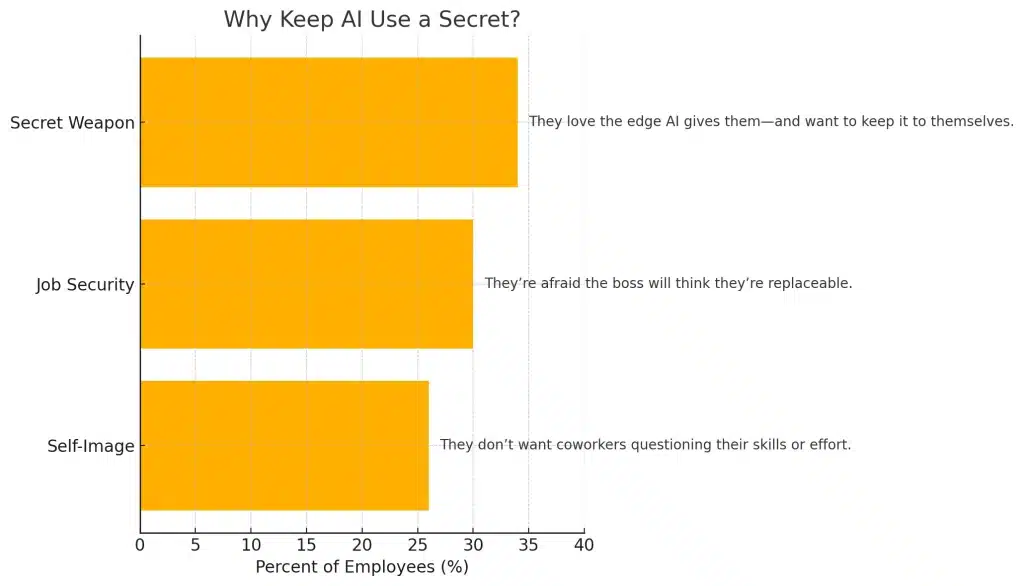
And it gets juicier—one in three workers are actively hiding their AI use from their bosses. Why? For some, it’s about keeping a “secret advantage” (36% say this is their main reason). Others are worried about job security (30% fear they’ll get the boot if caught), and a solid 27% just don’t want anyone questioning their abilities.
Executives: Out of the Loop and Underestimating the AI Surge
If you’re a manager reading this, brace yourself: you’re probably underestimating just how much your team is leaning on AI. A McKinsey report from January 2025 found that C-suite leaders think only 4% of employees use AI for at least 30% of their daily work. The reality? Employee self-reports put that number at more than three times higher.
This disconnect isn’t just a rounding error—it’s a canyon. While only a small slice of leadership expects employees to rely on AI for a third or more of their tasks in the next year, employees themselves are more than twice as likely to think that shift is already on the horizon.
Why the Secrecy?
So why all the cloak and dagger? Here’s the breakdown:
- Secret Weapon: Over a third of employees love the edge AI gives them and want to keep it to themselves.
- Job Security: Almost a third are worried that if the boss finds out, they’ll be out on the street.
- Self-Image: More than a quarter don’t want anyone questioning their skills or thinking they’re slacking off.
This hush-hush approach isn’t just about personal gain—it’s also a reaction to the lack of clear company policies. Many organizations haven’t caught up with the AI curve, leaving employees to figure out the rules (or lack thereof) on their own.
AI’s Shadow Extends to Schools and Universities
The AI secrecy game isn’t limited to the workplace. Schools and universities are also grappling with how to handle students’ growing reliance on AI. With graduation looming, many students are already using AI as a study buddy, and they’re likely to bring those habits into their first jobs.
But experts are waving the caution flag. J.T. Bushnell, a senior writing instructor at Oregon State University, warns that over-reliance on AI can lead to isolation. Sure, AI can help you punch up an essay or draft a killer email, but it can’t replace the creative spark that comes from bouncing ideas off another human. As Bushnell puts it, “You can also get these same benefits from speaking to another human. Like an improvement in the social aspect of your day”.
The Productivity Paradox: Boost or Bust?
Let’s not kid ourselves—AI is a productivity powerhouse. It can draft reports, summarize meetings, and even help you code faster than you can say “deadline.” But there’s a flip side. If everyone’s quietly outsourcing their work to AI, what happens to teamwork, creativity, and those spontaneous “aha!” moments that come from real collaboration?
There’s also the risk of creating a workplace where nobody knows who’s actually doing the work—the employee or the algorithm. That could lead to trust issues, both between employees and managers, and among coworkers themselves.
Why Companies Need to Catch Up—Fast
The genie is out of the bottle, and there’s no putting it back. Companies that ignore the AI undercurrent risk falling behind—not just in productivity, but in attracting and retaining top talent. Employees are already using these tools, and the ones who aren’t are probably thinking about it.
Here’s what smart organizations should be doing right now:
- Set Clear Guidelines: Don’t just ban AI or pretend it doesn’t exist. Create policies that encourage responsible use and transparency.
- Train Up: Offer workshops and resources so everyone can use AI effectively—and ethically.
- Foster Collaboration: Remind employees that AI is a tool, not a replacement for human connection. Encourage brainstorming, teamwork, and creative problem-solving.
- Open the Conversation: Make it safe for employees to talk about how they’re using AI. The more you know, the better you can adapt.
The Bottom Line
AI isn’t coming for your job—it’s already sitting at the next desk over. The real question is whether you’ll use it as a secret weapon or a team player. The companies that thrive will be the ones that embrace the AI revolution, set smart boundaries, and keep the human touch alive.
So, next time you see your coworker knocking out tasks at lightning speed, don’t just assume they’ve had too much coffee. They might just have a little help from their digital friend—and unless your company catches up, that secret advantage isn’t going anywhere.
