

Trump’s “Anti-Woke AI” Executive Order Just Changed Everything for AI
President Trump’s July 2025 executive order mandating “unbiased AI principles” for federal contracts is about to reshape how every major tech company thinks about AI training. This isn’t just another political talking point—it’s a seismic shift that could fundamentally alter how AI models get built, trained, and deployed.
Let me break down what’s actually happening here, why it matters more than you think, and what it means for the future of artificial intelligence in America.
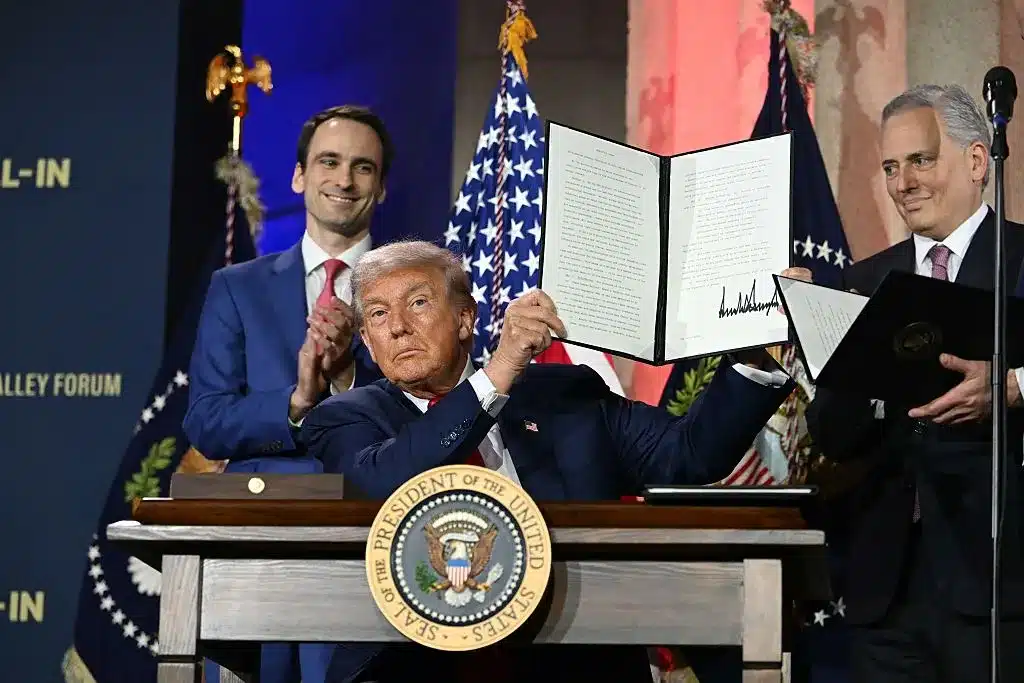
Image Credits: ANDREW CABALLERO-REYNOLDS/AFP / Getty Images
What Trump’s Executive Order Actually Does
The order directs federal agencies to only procure large language models that adhere to “Unbiased AI Principles”, which the administration defines in two specific ways:
Truth-seeking: LLMs must prioritize historical accuracy, scientific inquiry, and objectivity, acknowledging uncertainty where reliable information is incomplete or contradictory.
Ideological neutrality: LLMs must be neutral, nonpartisan tools that don’t manipulate responses in favor of ideological dogmas like DEI, and specifically excludes concepts like critical race theory, transgenderism, unconscious bias, intersectionality, and systemic racism.
Here’s the kicker: Federal contracts for LLMs must include terms ensuring compliance with these principles, including provisions that hold vendors accountable for costs if contracts are terminated due to noncompliance.
The Multi-Billion Dollar Stakes
AI companies Anthropic, Google, OpenAI and xAI just received Defense Department contracts worth up to $200 million each. When you’re talking about federal AI procurement across all agencies, we’re looking at potentially hundreds of billions of dollars over the next decade.
Companies seeking federal contracts could potentially lose hundreds of billions of dollars in future revenue if they fail to comply, creating powerful economic incentives for tech firms to adjust their AI systems.
That’s not hypothetical money—that’s real revenue that could make or break AI companies in an industry where most firms are burning cash faster than they can raise it.
Why Tech Companies Are Freaking Out
“The AI industry is deeply concerned about this situation,” said Neil Sahota, a UN AI advisor. “They’re already in a global arms race with AI, and now they’re being asked to put some very nebulous measures in place to undo protections because they might be seen as woke. It’s freaking tech companies out.”
The problem isn’t just philosophical—it’s practical. Experts say vague descriptions like “ideological bias” will make it challenging to shape and enforce new policy. Will there be a new system for evaluating whether an AI model has ideological bias? Who will make that decision?
Think about it: How do you objectively measure “ideological neutrality” in an AI system? The order’s central challenge lies in defining what constitutes “bias” versus “truth.” By explicitly prohibiting concepts like systemic racism and unconscious bias, the administration is imposing its ideological framework rather than achieving true neutrality.
The Technical Reality: True Neutrality Is Impossible
Here’s what most people don’t understand about AI bias: AI models are not politically neutral nor free from bias. More importantly, it may not even be possible for them to be unbiased. Throughout history, attempts to organize information have shown that one person’s objective truth is another’s ideological bias.
Bias in AI systems is often seen as a technical problem, but research shows that a great deal of AI bias stems from human biases and systemic, institutional biases as well. Every dataset reflects the biases of the humans who collected, curated, and labeled it.
Recent studies back this up. Research consistently finds significant evidence of left-leaning ideological bias in LLM responses, and given the well-documented trust that users place in this technology, this evidence has implications for how research and policy institutes and their ideas are consumed by the public.
How Companies Are Likely to Respond
One possible way AI companies could respond is to unveil “anti-woke” versions of their chatbots with fewer safeguards in order to land the lucrative business of the federal government.
I’m already hearing whispers in the industry about companies developing separate model versions specifically for government contracts. Companies could potentially create “anti-woke” versions of their chatbots with fewer safeguards to secure lucrative government contracts.
This creates a fascinating technical challenge: How do you maintain model performance while satisfying politically-motivated constraints? Some experts fear that AI companies will actively rework training data to toe the party line, with one industry leader suggesting they could “rewrite the entire corpus of human knowledge, adding missing information and deleting errors,” which would put individuals in the position of judging what is true.
The Broader Impact on Innovation
These burdens will hit the innovative potential of smaller AI developers worst. Tech giants like Alphabet, Microsoft, Meta, and OpenAI can absorb the cost and legal risk of navigating ideological compliance. But for startups and smaller firms, developing AI under a system where political ideology trumps technological excellence will be challenging and perhaps discouraging.
This is where the order could have unintended consequences. The focus represents a marked change from the Biden administration’s concerns about AI bias based on race or ethnicity. Republican concerns about AI have focused more on free speech and content moderation.
What This Means for You
The new policies may have downstream impacts on free speech, potentially censoring how AI can talk about race, gender, climate, or inequality. If you use AI tools for research, writing, or decision-making, you might start noticing changes in how these systems respond to certain topics.
AI will play a critical role in how Americans learn new skills, consume information, and navigate daily lives. Americans require reliable outputs from AI, but when ideological biases are built into models, they can distort the quality and accuracy of output.
The Global Competition Angle
Here’s the geopolitical context that makes this even more complex: When Chinese AI firms like DeepSeek and Alibaba released their models, Western researchers noticed they sidestepped questions critical of the Chinese Communist Party, engineered to reflect Beijing’s talking points. American AI leaders have pointed to this as justification for advancing their tech quickly without too much regulation.
Now we’re essentially doing the same thing, just with different political constraints.
Looking Ahead: Implementation Challenges
OMB has 120 days to issue guidance on new terms that agencies should include in contracts buying large language models. That’s not a lot of time to figure out how to objectively measure subjective concepts like “ideological neutrality.”
Despite its framing, the order’s immediate reach is relatively narrow, focusing primarily on federal AI procurement practices which don’t impose direct restrictions on private-sector AI use. However, federal procurement standards have historically influenced broader industry norms.
The real question isn’t whether this executive order will change how AI companies operate—it’s how quickly and how dramatically. With billions in federal contracts on the line, expect to see rapid changes in how major AI labs approach model training, safety measures, and content policies.
This is just the beginning of a much larger conversation about who gets to decide what constitutes “neutral” AI in an increasingly polarized world.
Sources:
- The White House – Fact Sheet: President Donald J. Trump Prevents Woke AI in the Federal Government: https://www.whitehouse.gov/fact-sheets/2025/07/fact-sheet-president-donald-j-trump-prevents-woke-ai-in-the-federal-government/
- NPR – What does Trump’s ‘Woke AI’ executive order mean for tech?: https://www.npr.org/2025/07/23/nx-s1-5476771/trump-artificial-intelligence-woke-eo
- CNBC – No ‘woke AI’ in Washington, says Trump: https://www.cnbc.com/2025/07/24/no-woke-ai-in-washington-says-trump-as-he-launches-ai-action-plan.html
- Brookings Institution – Trump’s executive orders politicize AI: https://www.brookings.edu/articles/trumps-executive-orders-politicize-ai/
- TechCrunch – Trump’s ‘anti-woke AI’ order could reshape how US tech companies train their models: https://techcrunch.com/2025/07/23/trumps-anti-woke-ai-order-could-reshape-how-us-tech-companies-train-their-models/
