

Unlock Your AI’s True Potential: Prompt Generator is the Secret Weapon I Use Daily to Master Any Task

Chad here, and if you’re anything like me, you’ve probably spent a good chunk of your recent professional life trying to coax the perfect output from AI. Whether it’s ChadGPT, ChatGPT, Claude, Gemini, or any of the other brilliant minds in the digital ether, they’re only as good as the instructions you give them. And let me tell you, what started as a “helpful skill” – prompt engineering – has rapidly become the damn operating system of modern productivity. Forget just typing in a few keywords and hoping for the best; we’re in the era of sophisticated AI conversation, and if you’re still brainstorming prompts from scratch, you’re working too hard.

Image Created by ChadGPT AI Image Creator
I used to be like you. Typing, deleting, re-typing, trying to hit that sweet spot of specificity without over-explaining. But then I stumbled upon a game-changer: the meta-prompt generator. This isn’t just a tool; it’s a system that builds optimized prompts on the fly, tailoring them to your input, your desired style, and your ultimate goal. It’s transformed my daily workflow, saving me hours every week, and today, I’m going to pull back the curtain and show you exactly how I leverage this beast, why it’s so effective, and how you can replicate my setup.
What Exactly Is Prompt Engineering, Anyway?
Before we dive into the meta-magic, let’s quickly define what we’re talking about. At its core, prompt engineering is the art and science of crafting effective inputs (prompts) to guide large language models (LLMs) like Google’s Gemini or OpenAI’s ChatGPT to generate desired outputs. Think of it as speaking the AI’s language, giving it clear, precise instructions and context so it can understand your intent, follow directions, and spit out something genuinely useful.
The quality of your prompt directly impacts the quality of the AI’s response. A vague request like “Write something about AI” will get you, well, something vague. But “Write a 500-word blog post for a SaaS company on the benefits of integrating AI into content marketing, optimized for SEO with relevant keywords, in a professional yet engaging tone” – now that’s a prompt that gets results. It’s about being the conductor of your digital orchestra, ensuring every instrument plays its part perfectly.
Why You Need a Prompt Generator in Your Arsenal
Here’s the cold, hard truth: Different LLMs excel at different things. ChatGPT (especially GPT-4) is often surgical with structure and great for detailed plans or crisp copy. Claude Opus is known for its softer, more reflective tone, making it ideal for human-sounding interactions. Gemini 1.5, on the other hand, is lightning-fast and fantastic for outlines or comprehensive research. The problem? One prompt rarely fits all three. Trying to manually adapt your prompts for each AI’s nuances is a monumental waste of time.
This is where a prompt generator, or more specifically, a meta-prompt generator, steps in. An AI prompt generator is a sophisticated software tool that uses AI itself to create and refine input instructions for other AI models. Instead of you manually crafting every detail, you tell the generator what you want to achieve, and it builds an optimized prompt for you.
Here’s why it’s become indispensable for me:
- Efficiency: It slashes the time spent on crafting precise prompts. No more staring at a blank screen wondering how to phrase things perfectly.
- Consistency: It helps generate uniform responses across multiple queries or even different AI models.
- Customization: Prompts can be tailored for specific industries, tasks, or even the desired output format and tone.
- Overcoming “Blank Page” Syndrome: Just like LLMs can help writers with outlines, a meta-prompting tool can establish a solid prompt structure when you’re feeling stuck.
- Bridging AI Differences: My meta-prompt generator understands the strengths of various LLMs and crafts prompts accordingly, ensuring I get the best out of each.
It’s not just about prompting; it’s about prompt design. It’s about asking the AI how to ask itself better.
Chad’s Go-To Meta-Prompting Strategy: The “Prompt Engineer” Trick
My daily flow has been revolutionized by this simple yet powerful meta-prompting strategy. I use it every morning to prep my AI stack for the day, whether I need a legal email, a dev spec, or a viral social media thread idea.
Instead of pasting the same meta-prompt every time, I built a reusable ChadGPT Project that handles this for me—perfectly, every time.
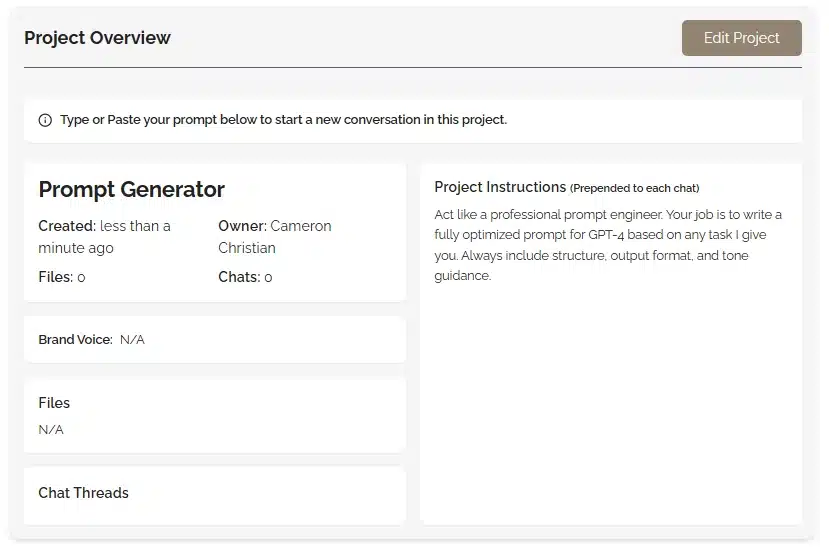
Here’s how it works: I created a Project in ChadGPT called “Prompt Generator” and set the custom instructions like this:
“Act like a professional prompt engineer. Your job is to write a fully optimized prompt for GPT-4 based on any task I give you. Always include structure, output format, and tone guidance.”
Now, whenever I open that Project and type in something like:
“Help me write a customer apology email for a delayed shipment.”
…it instantly returns a clean, well-structured prompt I can use or adapt. No copy-pasting meta-prompts. No re-explaining what I want. Just one reusable workspace that nails the job every time.
This is where ChadGPT Projects shine—they let you lock in your intent, style, and expectations, and then reuse that setup across dozens of use cases. Once you’ve got it dialed in, it’s like having your own personal prompt engineer on call 24/7.
Now, let’s break down why this works so brilliantly:
- “Act like a prompt engineer.” This is a powerful role-based instruction. By assigning a persona, you’re telling the AI to leverage its training data and simulate the thinking process of an expert in that field. It effectively becomes a highly skilled prompt consultant for you.
- “Based on the following task, write a full prompt optimized for GPT-4.” This specifies the ultimate goal (a new prompt) and tailors it for a particular model. While my initial prompt might target GPT-4, I can easily swap that out for “Claude” or “Gemini” if I know that model is better suited for the final output. Remember, different LLMs have different strengths.
- “Include structure, output format, and tone.” This is where the magic truly happens. It forces contextual precision. Instead of just getting a few keywords, the meta-prompt ensures the generated prompt will include critical elements often overlooked:
- Structure: Does it need bullet points, a numbered list, a paragraph, a table?
- Output Format: Is it a blog post, an email, code, a script, a summary?
- Tone: Professional, informal, humorous, serious, confident, empathetic?
Here’s a real-world example of the flow:
Let’s say I want to launch a 7-day email course on productivity for freelancers.
- My initial input to the meta-prompt generator: “I want to launch a 7-day email course on productivity for freelancers.”
- Meta-prompt generator’s response (the new prompt it gives me): “Create a multi-part prompt to build a 7-email sequence. Each email should address a specific freelance struggle (time management, client scope creep, imposter syndrome), include a clear Call to Action (CTA), and sound human and relatable. Use GPT-4 for the initial copy generation and then refine the tone using Claude for a more empathetic approach.”
See that? It didn’t just give me the course. It gave me the strategy for generating the course using multiple AI tools with their respective strengths! I then take that detailed, optimized prompt and feed it into the appropriate LLM(s). Boom. Full course. No overthinking. Clear tone, smart sequence, ready to launch. It’s like having a master chef design the recipe before you even touch the ingredients.
Beyond the Basics: Advanced Prompting Techniques
While the meta-prompt generator handles a lot of the heavy lifting, understanding some underlying prompt engineering principles will make your outputs even better. These techniques are what the meta-prompt generator is essentially applying behind the scenes.
1. Be Clear and Specific (Always!)
This is the golden rule. Ambiguity is the enemy of good AI output. Don’t just say “make it better”; define what “better” means (e.g., “shorter sentences,” “more engaging,” “professional tone”). The more specific you are about your desired outcome, length, format, and style, the more likely the AI is to deliver.
- Bad Prompt: “Summarize this article.”
- Good Prompt: “Summarize the following article in three concise bullet points that highlight its key arguments. Avoid including any opinion or unnecessary detail.”
2. Provide Context and Background
Giving the AI relevant background information helps it understand the desired task better, leading to more accurate and relevant outputs. If you’re asking for a creative story, describing the desired tone or theme can significantly improve results.
- Example: “You are an experienced wildlife biologist specializing in trees. Create a recipe using these ingredients: [list ingredients]. The recipe should be healthy and designed to refuel after a workout.” (Combines role-based prompting with context).
3. Use Action-Oriented Verbs
Start your prompts with strong action verbs like “Generate,” “Summarize,” “Translate,” “Create,” or “Analyze.” This gives the model a clear directive and cuts through the noise.
4. Iterative Refinement
Prompt engineering is rarely a one-shot deal. It’s an iterative process. Start with an initial prompt, review the response, and then refine your prompt based on the output. You can build on previous prompts, changing wording, tone, or adding more context to guide the AI towards your desired outcome.
5. Few-Shot Prompting
This involves providing a few examples of desired input-output pairs within your prompt. It teaches the model the exact structure or tone you want it to mimic, which is incredibly useful for complex tasks or specific formatting needs (like generating code or structured data).
- Example: “Here are two examples of product descriptions for eco-friendly products. Write a third in the same style: [Example 1], [Example 2].”
6. Chain-of-Thought (CoT) Prompting
For complex problems, don’t ask the AI to jump straight to the answer. Instead, ask it to break down the problem into smaller, sequential steps or “think step-by-step.” This encourages the AI to reason out loud before giving its final answer, reducing hallucinations and encouraging deeper, more accurate responses.
- Example: “Given a party where each guest has a unique music preference and only a limited number of genres can be played, walk me through the analysis in manageable steps to determine how many guests can attend based on their music preferences.”
7. Tree-of-Thought (ToT) Prompting
Building on CoT, ToT allows the LLM to explore multiple coherent units of text (“thoughts”) as intermediate steps, especially useful for multi-step planning or design challenges where multiple solution pathways need to be explored.
- Example: “Design a coffee cup that maintains drink temperature for a longer period. First, list several initial design ideas. Then, for each idea, assess its feasibility and potential effectiveness. Finally, choose the most promising option and elaborate on its features.”
8. ReAct (Reason and Act)
This technique encourages the model to alternate between reasoning and taking action. You instruct it to hypothesize, “act” on that hypothesis (simulating a search or data retrieval), review the outcome, and adjust its approach accordingly. Ideal for iterative, data-driven tasks.
- Example: “Identify the most relevant keywords for electric vehicle market trends. Then, simulate a search for news articles using those keywords and summarize the key findings.”
The Future is Prompt-Optimized (But Maybe Less Obvious)
As AI models become increasingly sophisticated, the “future of prompt engineering” is fascinating. Some predict that as models improve in understanding natural language, the need for users to explicitly learn prompt engineering will diminish. AI systems like Google’s Gemini or OpenAI’s ChatGPT are already becoming more self-sufficient in interpreting vague prompts. We might see more intuitive natural language interfaces where you can just “talk” to the AI like another person, with auto-prompting systems suggesting or creating prompts for you behind the scenes.
However, for those of us pushing the boundaries of what AI can do, prompt engineering won’t disappear; it will evolve. It will likely become a highly specialized skill, integrated into roles that require precise control over AI outputs, much like coding became less universally essential with the rise of no-code platforms, but still crucial for developers. The focus will shift from just writing a prompt to designing how that prompt fits into a larger system or workflow. Tools will continue to evolve, offering more advanced features like automation, multi-modal AI integration (handling text, images, video, code), and sophisticated data validation. We’ll see more prompt pattern libraries, best practices, and ethical guidelines for prompting become standard.
So, while the AI might get better at understanding us, the strategic use of prompt generators and a deep understanding of advanced prompting techniques will remain vital for maximizing efficiency, achieving nuanced results, and truly unlocking the boundless potential of AI. It’s not just about getting an answer; it’s about getting the right answer, every single time. And with a meta-prompt generator in your corner, you’re not just ready for the future; you’re already living in it.
